1. Logical Creation of a Mirror Universe

2. Identity

Carroll spends a lot of time looking at identity in both this book and "Alice's Adventures in Wonderland". In the first book, several characters ask Alice "Who are you?" and she is unsure about how to answer them. She has grown to the point where she isn't the same person she was yesterday and if she didn't even know who she was yesterday, how is she to know who she is today or who she will be tomorrow? In this book, Carroll looks at identity by looking at the concept of naming. When Alice is about to enter an area where she could potentially forget her name, the gnat that is talking to her says that this wouldn't be so bad. If Alice had no name, after all, no one could give her orders because they couldn't prove that they are actually addressing her. When Alice enters this wood, she is very distressed by her inability to know her own name and leaves that area as swiftly as she can. At another point, Alice is criticized for her name because the people of this mirror world believe that a name should describe the thing it is assigned to (For example a bread-and-butter fly looks exactly as you may expect it to look) and that an "Alice" could be pretty much anything. Our names are very important to us, even if they don't define us directly (I'm really not sure what an "Emma" would look like exactly but I do know that at least one of them looks like me and is me) and we cannot imagine ourselves without them.
3. Meaning
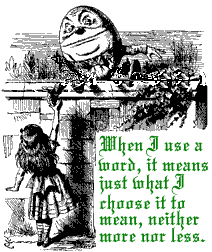
So, we've all heard the phrase "Don't get caught up in semantics", well Alice literally does get caught up in semantics when she is talking to Humpty Dumpty. Humpty constantly redefines words and claims that he has the power to make a word mean whatever he wants it to mean (It's because he pays them extra). Sometimes this involves taking a word and claiming that it "means" a whole extended sentence. Alice asks Humpty Dumpty for help in deciphering the first (And Last) stanza of the Jabberwocky poem. Humpty provides a reasonable definition for each of the terms you don't initially understand (Which is pretty much all of the terminology used in the first verse) and seems to provide a good overall translation of this stanza...the problem is that you don't fully trust what Humpty Dumpty comes up with because of his previous statement about making words mean whatever he wants them to mean. What is the true meaning of the stanza? Can you trust a person who makes their own meaning to provide a truthful transcription? In the end, I'm really not all that sure that Humpty Dumpty's translation is a true understanding of that first stanza.
4. Carroll's Humor

I would just like to take this moment to point out that Lewis Carroll is hilarious! Many of his jokes come from excessive literalization or logic. For example, at one point, Alice is trying to get inside a door. She asks a nearby frog "How do I answer the door?" and the frog responds by asking something to the effect of: "Well, what question did the door ask you?". At another point Alice is explaining all the names of bugs that exist in her world to a nearby gnat, the gnat surmises that this might help Alice to summon these bugs when she needs to but when Alice tells him that she is afraid of bugs and that the bugs probably wouldn't respond, the gnat says "What's the use of them having names if they won't answer to them". At another point, the White queen offers to hire Alice and pay her in jam (Among other things). When Alice says that she doesn't like jam, the queen responds by saying that it is "very good jam". When Alice is talking to Humpty Dumpty, she says that "one can't help growing older" and Humpty responds by saying "one can't perhaps...but two can. With proper assistance". Lastly, there is a scene where Alice is about to cut a leg of mutton, she is unsure about what to do, so the Red Queen introduces her to the mutton leg. After this Alice offers to give the queen a slice of mutton and the queen says that it is rude to chop something up after you have been introduced to it. These and many other jokes are buried in Carroll's work (And not buried too deeply either), so Rachel and I spent about half the time reading and the other half laughing hysterically.
So, we've all heard the phrase "Don't get caught up in semantics", well Alice literally does get caught up in semantics when she is talking to Humpty Dumpty. Humpty constantly redefines words and claims that he has the power to make a word mean whatever he wants it to mean (It's because he pays them extra). Sometimes this involves taking a word and claiming that it "means" a whole extended sentence. Alice asks Humpty Dumpty for help in deciphering the first (And Last) stanza of the Jabberwocky poem. Humpty provides a reasonable definition for each of the terms you don't initially understand (Which is pretty much all of the terminology used in the first verse) and seems to provide a good overall translation of this stanza...the problem is that you don't fully trust what Humpty Dumpty comes up with because of his previous statement about making words mean whatever he wants them to mean. What is the true meaning of the stanza? Can you trust a person who makes their own meaning to provide a truthful transcription? In the end, I'm really not all that sure that Humpty Dumpty's translation is a true understanding of that first stanza.
4. Carroll's Humor

5. Life as a Dream

For both "Alice's Adventures in Wonderland" and "Through the Looking Glass", the vast majority of the events that take place are actually a dream, this could make some people upset because none of it is "real". In fact Tolkien mentions in an essay he wrote called "On Fairy Stories" that if a story could be entirely explained away as a dream, it cannot be a real fantasy world. In this story, Alice is told that she isn't actually a living being, but rather a character in the Red King's dream, Alice finds this somewhat irritating because she would much rather be the one dreaming and have everyone else exist as a character. At the end, we still aren't entirely sure if Alice dreamed the whole thing or if the Red King did and Carroll even asks the reader's opinion on the matter. Unlike Tolkien, I think that Carroll thought that dreams could serve as a "real" thing, that they could capture aspects of reality and that reality in essence was a dream. I think philosophers like Descartes and Kant talk about it too, what we know about the world comes from the way that we perceive things through our senses, but it may not be the way things really are, just the way that we perceive them to be. Carroll ends his story with a poem that says: "Life, what is it but a dream". What if we die immediately awaken to find that our entire life has just been a very vivid dream.


No comments:
Post a Comment